
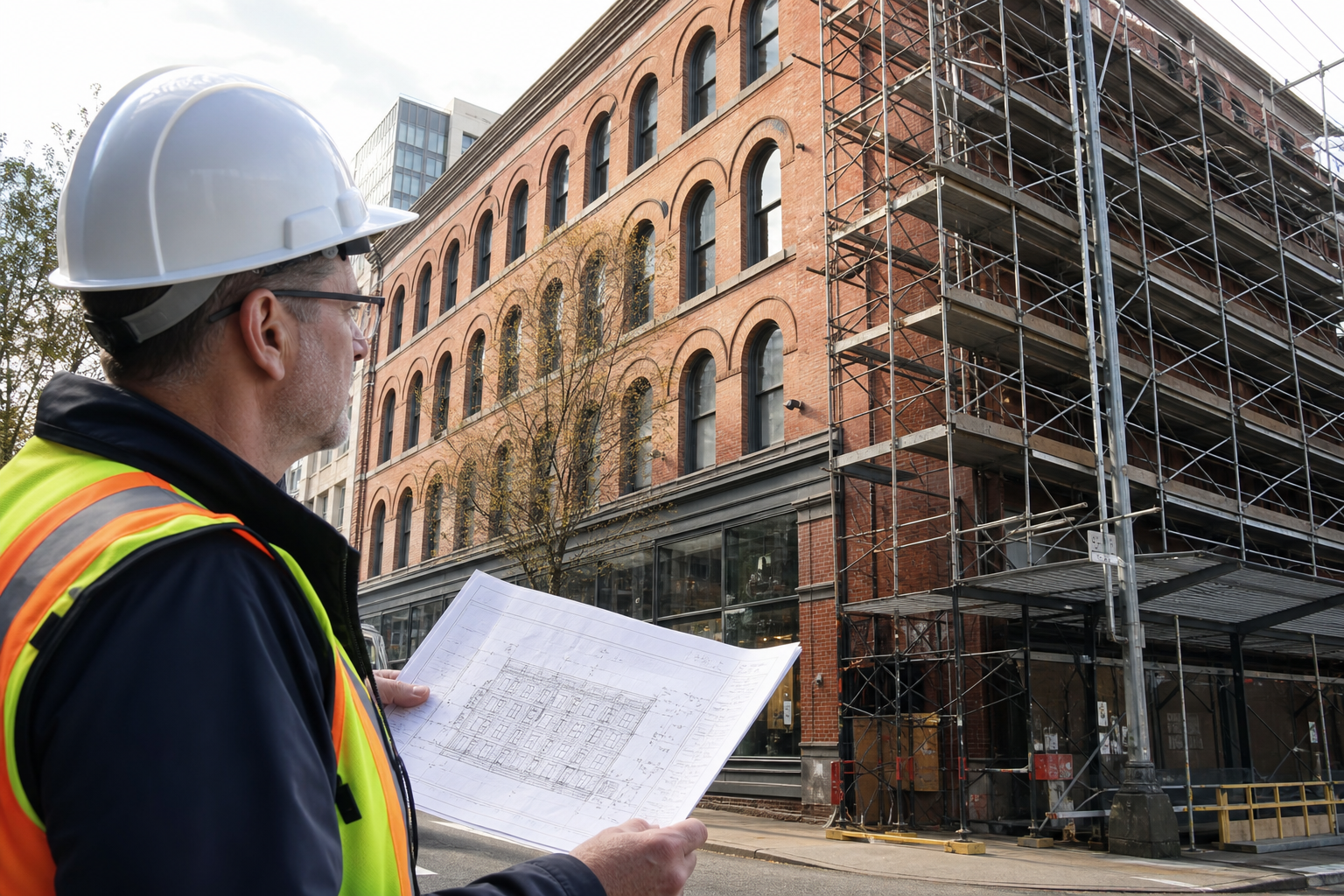
For Seattle unreinforced masonry (URM) owners, completing work is only half the story. You also need official recognition that a compliance retrofit meets Seattle Existing Building Code (SEBC) Section 304.5.1. When SDCI confirms that pathway, your building’s Confirmed Compliant Retrofit column in the SDCI URM database can move to “Yes”—a visible form of Seattle URM recognition that lenders, buyers, and insurers increasingly expect.
Why Confirmed Compliant Retrofit Status Matters
Seattle’s URM seismic regulations set a minimally acceptable life-safety standard for earthquake risk. Retrofitted buildings stay listed in the inventory; they are not automatically removed. Status confirmation documents that the work satisfies SEBC 304.5.1 rather than remaining an informal or incomplete upgrade.
Official program context is available on the City of Seattle Unreinforced Masonry Buildings FAQ page and in SDCI Tip 345.
- Clarity for transactions: Confirmed status reduces ambiguity when a property changes hands or is refinanced.
- Alignment with future mandates: The standard is voluntary today; the city intends mandatory compliance later, so early documentation protects schedule options.
- Record permanence: Recognition is filed through a Land Use Analysis Request that stays with the property.
SEBC 304.5.1 Pathways for a Compliance Retrofit
Section 304.5.1 allows owners to demonstrate compliance through one of several recognized routes. Choosing the correct pathway determines what evidence SDCI requires.
New or Substantial Alteration Pathways
Item 1 allows retrofit to the level required for a substantial alteration under SEBC 304.4.2. Item 2 allows the Alternate Method in Appendix Chapter A6—often a more targeted scope for qualifying buildings, addressing parapets, wall anchorage, and diaphragm connections. Not every URM qualifies for A6; SEBC A603 lists eligibility criteria.
Previously Completed Retrofits
Item 3 covers work already permitted and finished:
- Item 3a (Sept. 16, 1996–April 24, 2009): Substantial-alteration retrofits under the 1994 or later Seattle Building Code generally need a sealed structural engineer’s report describing the retrofit level and mitigated deficiencies.
- Item 3b (after April 24, 2009): Substantial-alteration retrofits under the 2006 or later SBC typically require the SDCI permit number so staff can evaluate compliance; photographs may also be requested.
- Item 3c (other retrofits): Voluntary or alternate upgrades that may meet the intent of SEBC 304.5 need a sealed engineer’s report and, often, pre-submittal coordination with SDCI.
A well-scoped retrofit strategy matches your building’s permit history to the pathway with the clearest documentation trail.
How to Apply for Seattle URM Recognition
Recognition is not automatic after construction. Owners apply through the Seattle Services Portal using a Land Use Analysis Request and selecting URM Retrofit Verification as the letter type. Upload the recognition application form, seismic evaluation report when required, and supporting documents such as photos or prior permits.
SDCI reviews the package against SEBC 304.5.1. If approved, status in the SDCI URM database updates to retrofitted / Confirmed Compliant Retrofit = Yes, and the adjacent method column reflects the approved pathway. Owners receive written notice, and the decision is recorded with the property. If the retrofit no longer fits the URM definition, a separate appeal may be needed to remove the listing entirely.
For engineering support through evaluation and permit-ready design, explore ProStruct’s Washington seismic retrofit and foundations services.
ProStruct Engineering: Your Partner for Compliance Retrofit Recognition
Are you trying to turn past seismic work—or a planned upgrade—into confirmed status under SEBC 304.5.1?
Enter ProStruct Engineering!
At ProStruct Engineering, we help Seattle and Washington owners navigate structural evaluation, calculations, and documentation that support Seattle URM recognition. On the back of vast industry experience, we connect code pathways to clear submittals rather than guesswork.
Our Key Features
- Pathway selection: We review permit history and as-built conditions to identify the strongest SEBC 304.5.1 route for your building.
- Sealed reporting: When Items 3a or 3c apply, we prepare engineer-sealed reports that describe completed work and residual risk in language reviewers expect.
- Permit-focused design: For new Alternate Method or 304.4.2 scopes, we deliver calculations and details suited to SDCI review.
- Transparent coordination: Owners, contractors, and consultants stay aligned on evidence, portal submittals, and next decisions.
Learn more about ProStruct’s Washington structural engineering services when you need a single partner from assessment through recognition support.
Confirmed Compliant Retrofit – Frequently Asked Questions (FAQs)
Q) Does Confirmed Compliant Retrofit status remove my building from the SDCI URM database?
No. Retrofitted buildings generally remain listed with updated status. Removal requires a separate appeal if the building no longer meets the URM definition.
Q) Is a contractor invoice enough for Seattle URM recognition?
Usually not. SDCI expects pathway-specific evidence—often a permit number, sealed engineer’s report, and/or photos—submitted through the URM Retrofit Verification process.
Q) Can voluntary work completed years ago still qualify?
Possibly under Item 3c if the retrofit meets the intent of SEBC 304.5 and SDCI approves the documentation. Early coordination with the URM program is recommended.
Q) What should owners gather before hiring an engineer?
Collect SDCI notices, prior permits, drawings, retrofit photos, and any substantial-alteration determinations tied to the property.
Conclusion
Earning Confirmed Compliant Retrofit status under Seattle SEBC 304.5.1 is a documentation and engineering exercise as much as a construction one. Selecting the correct pathway, assembling evidence, and securing SDCI approval turns a finished compliance retrofit into recognized standing in the SDCI URM database.
ProStruct Engineering comes to help clients on the back of vast industry experience and expertise. We have the right set of skills and potential to handle your URM evaluation and retrofit documentation with utmost proficiency. Whether it is a residential or commercial project, ProStruct Engineering is there to exhibit a level of professionalism for all types of seismic retrofit requirements in Washington—contact us to start your recognition roadmap.